
How AI Is Rewriting Product Marketing: Launch Faster, Scale Smarter
Every product marketer knows the pressure: launch faster, hit harder, do more with less. Yet even the best teams struggle to keep up with markets that evolve weekly, customer expectations that change overnight, and leadership demanding constant growth at scale.
The pace of technology adoption, AI in particular, is reshaping the entire rhythm of product marketing and go-to-market execution.
For years, product marketing operated like a well-rehearsed orchestra: research, messaging, enablement, launch, measure, repeat. Today, it feels more like a jazz session, fluid, reactive, improvisational.
Artificial intelligence isn’t replacing that rhythm; it’s amplifying it. Used wisely, AI tools are helping product marketing teams:
- Launch products faster by automating strategy and content foundations.
- Scale at pace through adaptive, real-time audience targeting and message testing.
- Collaborate better by freeing humans to focus on creative storytelling, positioning, and emotional insight — the parts machines can’t replicate.
As McKinsey’s 2025 State of Marketing Report notes, “AI is not just accelerating marketing work, it’s redefining the concept of launch speed, enabling product teams to learn and adapt in near real-time.”
This article explores how AI is reshaping product marketing, not as a replacement for human insight, but as a powerful partner. Together, human creativity and machine intelligence are redefining what it means to take a product to market in 2025 and beyond.
Why Product Launches Are Changing — Fast
The days of multi-month, manually orchestrated product launches are numbered. In an era of instant feedback and hyper-competitive innovation, success depends on launch velocity, or how quickly teams can move from idea to impact.
In the past, a product launch was a campaign milestone. Now, it’s a living, data-driven system that evolves continuously based on market signals.
Gartner’s 2025 Product Marketing Outlook finds that nearly 60% of B2B marketing leaders plan to shorten their launch cycles by half within the next two years, citing AI-powered automation and insight acceleration as the key drivers.
Why the urgency? Because technology cycles themselves have compressed. SaaS updates roll out weekly. Hardware refreshes happen quarterly. Buyer expectations, trained by real-time, B2C-like experiences, demand immediacy.
In other words, if you’re launching at yesterday’s speed, you’re already late.
As Harvard Business Review observed in The New Rules of Launch Velocity (2025), “The distance between innovation and adoption has collapsed, AI has turned product marketing from a function of planning into a function of momentum.”
How AI Tools Are Redefining Product Marketing Workflows
The best AI tools aren’t just making product marketing faster, they’re making it more intelligent.
Let’s break down where AI is reshaping launch execution and campaign scalability today.
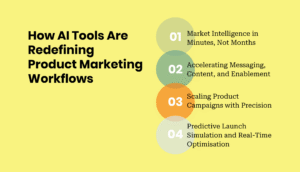
1. Market Intelligence in Minutes, Not Months
Where market analysis once took weeks of research and cross-team validation, generative AI can now synthesise vast data sets from reviews, search behaviour, competitor announcements, and social chatter into actionable insight in hours.
Platforms such as Crayon, GWI, and TelmarHelixa Discover use AI to surface audience psychographics, segment affinities, and whitespace opportunities almost instantly. Product marketers can now benchmark perception, track messaging resonance, and spot competitive shifts before launch.
This enables what Deloitte calls “real-time readiness”, the ability to adapt positioning based on emerging data, not static assumptions.
AI isn’t replacing strategic intuition here. It’s compressing the research window, giving human marketers a sharper, faster decision advantage.
2. Accelerating Messaging, Content, and Enablement
Messaging used to be the slowest part of the product marketing process. Endless rounds of copy refinement, stakeholder approval, and channel adaptation.
Now, large language models (LLMs) like GPT-5, Swyfter, Writer, and Jasper are enabling teams to:
- Generate first drafts of messaging frameworks and campaign assets in minutes.
- Personalise content for multiple personas or verticals at scale.
- Repurpose long-form content (whitepapers, sales decks) into multiple assets instantly.
For instance, one global software brand now uses an AI-assisted copy system to produce ‘launch kits’ in under 48 hours, complete with tailored landing pages, sales email templates, and ad variations. This allowed the software brand to see performance gains, such as content production time reduced by 70%, and time-to-launch cut from six weeks to ten days.
This is not about AI replacing writers. It’s about accelerating ideation and freeing humans to refine tone, emotion, and narrative depth.
As HubSpot’s 2025 AI in Marketing Report emphasises, “Teams using generative AI for first-draft creation are producing 3x more launch content without adding headcount, but the highest-performing teams still apply human review to every asset.”
AI writes faster. Humans make it resonate. Together, they move the market.
3. Scaling Product Campaigns with Precision
AI is also changing how product marketers scale campaigns post-launch.
Machine learning algorithms now optimise channel spend and creative variants in real time. Tools such as Meta Advantage+, Google Performance Max, and LinkedIn’s Predictive Audiences dynamically adjust ad combinations and placements to deliver the right message to the right user on a continuous basis.
In B2B, AI-assisted campaign orchestration platforms such as 6sense and Demandbase are helping product marketers focus budget and creative on high-intent accounts, reducing wasted spend by up to 30% (McKinsey, 2025).
This precision scaling mirrors what consumer marketers have done for years: real-time, data-driven, always-on campaign optimisation.
B2B is finally catching up, adopting what Gartner describes as a “B2C performance mindset, fast, responsive, and customer-data native.”
4. Predictive Launch Simulation and Real-Time Optimisation
Another frontier is predictive AI for launch scenario modelling.
AI systems can now simulate launch outcomes by analysing historical campaign data, audience sentiment, and pricing elasticity. This allows marketers to forecast not just engagement metrics, but launch risk, timing sensitivity, and messaging fatigue before a campaign even begins.
Once live, these systems monitor performance and adjust tactics automatically, shifting spend between channels, refreshing creative, or updating message emphasis based on engagement velocity.
It’s the equivalent of a marketing autopilot, but one that still requires a human pilot to steer strategy.
As Deloitte’s Tech Trends 2025 explains, “The next phase of marketing automation is not ‘hands off’, it’s ‘hands on faster.’ Humans set direction. Machines optimise execution.”
Scaling at Pace Without Losing Control
Faster doesn’t always mean better. One of the biggest risks in AI-driven product marketing is mistaking automation for acceleration.
True scale isn’t just about producing more; it’s about producing better, more relevant experiences for your audience.
That’s why successful organisations are pairing automation with oversight. AI handles scale; humans handle story.
Gartner’s 2025 Future of Product Marketing Leadership report found that companies using hybrid human plus AI workflows achieved 38% faster launches and 24% higher campaign ROI compared to automation-only teams. The reason? Human creativity ensures differentiation and brand alignment, the two things algorithms can’t feel.
It’s not AI or humans. It’s AI with humans.
Why the Human Element Still Matters
Even as AI becomes a co-pilot, product marketing remains a deeply human discipline. The essence of great product marketing — insight, empathy, narrative — can’t be automated.
- AI can detect what customers do. Only humans can interpret why.
- An algorithm can optimise ad frequency. Only humans can craft a story that earns loyalty.
- AI can accelerate messaging. Only humans can connect that message to purpose.
The most advanced organisations, from Adobe to Canva to HubSpot, are rearchitecting their launch playbooks to balance both. AI powers the data, automation, and speed. Humans steer the strategy, voice, and emotional resonance.
This partnership is the new productivity frontier: the fusion of creativity and computation.
The B2C Mindset: Personalisation, Agility, and Emotion at Scale
Interestingly, as AI brings speed and precision to product marketing, it’s also pulling B2B closer to a B2C mindset.
In consumer marketing, real-time engagement and hyper-personalisation have been the norm for years. Brands such as Nike, Spotify, and Netflix tailor experiences dynamically for millions of users simultaneously.
Now, B2B is adopting similar principles.
Adobe’s Experience Cloud, for example, uses AI to personalise content and product recommendations for enterprise buyers based on real-time behaviour. Salesforce’s Einstein AI helps sales and product teams surface the next-best-action for individual accounts.
This shift toward consumer-like agility is creating a new expectation: business audiences now want instant relevance and emotion, not just rational information.
As McKinsey’s Next Era of B2B Growth (2025) notes:
“B2B companies adopting B2C-style personalisation and experimentation achieve 2.3x higher engagement and 1.8x faster conversion rates.”
AI is the connective tissue that makes this possible, scaling human creativity to meet modern buyer expectations.
Case in Point: Launching Like a Consumer Brand
Take Canva’s enterprise expansion, launched in late 2024. Traditionally a consumer darling, Canva used AI-driven audience insights and generative content systems to identify how design teams and marketers collaborate in real time.
Their campaign mixed consumer-style storytelling (emotion-led, community-driven) with enterprise-grade targeting. Using AI-powered message variation testing, they refined their value proposition continuously during the rollout, increasing adoption across large accounts by 43% in the first quarter.
Similarly, HubSpot’s product launches now use AI to generate hundreds of ad and copy variants, which are A/B tested automatically across channels. The human creative team then curates the top performers into storytelling campaigns, resulting in faster launches, sharper stories, and measurable growth without burnout.
The Future of Product Marketing: Human + Machine as a Growth Engine
The next chapter of product marketing isn’t about automation alone. It’s about orchestration.
The orchestration of creativity and computation. Of empathy and analytics. Of human intuition and machine precision.
AI will continue to accelerate what’s possible; shorter cycles, smarter targeting, deeper insight. But the most powerful launches will come from teams who fuse that speed with soul.
In the words of Deloitte, “The future of product marketing belongs to teams who use AI not to replace human insight but to give it wings.”
If you can learn faster, adapt sooner, and connect deeper, you’ll not just keep up with the market. You’ll shape it.
FAQ: AI and the Future of Product Marketing
1. How is AI transforming product marketing?
AI is automating and accelerating every phase of the product marketing lifecycle, from market research and content creation to launch optimisation and performance analysis, allowing teams to move faster and scale campaigns efficiently.
2. Will AI replace product marketers?
No. The best results come from AI-augmented teams where humans handle strategy, creativity, and brand voice, while AI manages data, automation, and speed.
3. How is AI making product launches faster?
Through automation of repetitive workflows, predictive modelling for campaign timing, and real-time creative optimisation, cutting launch cycles by up to 50%.
4. Why is product marketing adopting a B2C mindset?
Because AI enables personalisation, agility, and emotional storytelling at scale. Business audiences now expect the same immediacy and experience quality they get as consumers.
5. What’s the biggest success factor for AI-powered product campaigns?
Human and machine collaboration, blending emotional intelligence with analytical precision to create relevant, resonant launches.
How Product Marketing Teams Can Start Their AI Evolution
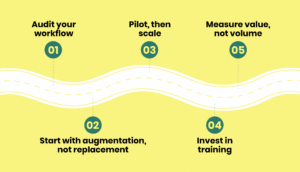
The question isn’t whether AI belongs in product marketing; it’s how to make it part of your DNA.
Here’s a human-first roadmap:
- Audit your workflow: Identify repetitive tasks (research, drafting, reporting) that can be safely automated.
- Start with augmentation, not replacement: Use AI to enhance creative, not erase it. Let humans lead strategy and emotion.
- Pilot, then scale: Test AI tools in one launch or campaign before wider rollout.
- Invest in training: Upskill your teams in prompt engineering, AI ethics, and creative co-piloting.
- Measure value, not volume: Track efficiency and engagement quality. Success is faster and better outcomes.
As Gartner points out:
“The best product marketers in the AI era are translators bridging the machine’s logic with the customer’s emotion.”
Ready to take the next steps in starting your product marketing AI evolution? Get started with Tomorrow People.
About the author:
Partner at Tomorrow People
Pete is a strategic marketing leader specialising in positioning, go-to-market strategy, growth and AI-enabled marketing performance. He has worked with organisations including Schneider Electric, TechData, Atos, Microsoft, Reachdesk, ABB, TelmarHelixa, Trustpilot, Company365, GlobalData and more, helping brands sharpen their market position, strengthen go-to-market execution and accelerate growth.
His work focuses on turning complex propositions into clear market narratives, aligning commercial teams around stronger positioning and improving marketing performance through the smart application of AI. From category development and messaging to launch strategy and growth planning, Pete brings a practical, commercially grounded perspective shaped by hands-on experience across B2B and enterprise environments.
Pete has also spoken at Content Marketing World, where he has contributed to industry conversations on positioning, growth and the changing role of AI in modern marketing. He writes about the strategies, decisions and operating models that help ambitious brands move faster, communicate more clearly and perform more effectively.
Read the latest positioning trends and insights.
Tap into our brand and product positioning, storytelling, and creative expertise to inspire your next strategic move.