
How 8 Market Leaders Are Using AI to Connect Sales, Marketing and Product
For decades, Go-to-Market (GTM) strategy has been defined by handoffs, from marketing to sales, from sales to product, from product to customer success. Each team measured success differently, spoke its own data language, and moved to its own rhythm.
But in 2026, that rhythm is changing.
AI is rapidly becoming the connective tissue that links every part of the commercial engine. It’s no longer enough to optimise each department in isolation; the real advantage now lies in alignment: a shared intelligence that synchronises insight and execution across the entire customer journey.
According to McKinsey’s State of Commercial Intelligence, companies using AI to unify GTM data across functions grow 20 to 30% faster than those still operating in silos.
Below, we explore eight real-world companies already showing what this future looks like; where AI doesn’t just automate tasks, but orchestrates collaboration between sales, marketing, product, and success.
1. Salesforce: From CRM Giant to GTM Intelligence Hub
Salesforce has spent decades helping businesses manage relationships. But now it’s teaching them how to align their GTM systems around one shared intelligence layer.
With Einstein GPT and Data Cloud, Salesforce connects marketing engagement, product telemetry, and sales pipeline activity in real time. AI models analyse every signal, from email open rates to deal progression, and automatically generate insights that both marketing and sales teams act on.
Companies using Einstein GPT report up to 28% shorter sales cycles and measurable gains in customer lifetime value, according to Salesforce’s own benchmark data.
As CEO Marc Benioff put it in a company earnings call,
AI is the unifier. It’s how data, trust, and productivity come together to make every part of your business more connected.
2. HubSpot: Turning Revenue Data into a Shared GTM Dashboard
While Salesforce leads at enterprise scale, HubSpot has become the small-to-midmarket benchmark for unified GTM intelligence.
Its ‘Smart CRM + AI Copilot’ architecture merges marketing automation, sales enablement, and service data into a single feedback loop. Every email sent, deal updated, and ticket resolved feeds into a central model that predicts conversion likelihood and churn risk.
HubSpot’s CTO Dharmesh Shah described this shift in HubSpot’s AI Innovation Report:
We’re not building separate tools for marketing or sales. We’re building one GTM system that learns across all of them.
This approach has turned HubSpot into more than a CRM. It’s effectively a GTM operating system for growing companies, proving that unified intelligence scales down as powerfully as it scales up.
3. Adobe: Converging Marketing, Product, and Experience
For Adobe, the next wave of marketing intelligence lies in experience orchestration.
Through its Adobe Experience Platform (AEP), powered by Adobe Sensei AI, the company connects marketing, product, and user data to deliver what Forrester calls “experience-led GTM intelligence.”
Imagine a scenario where product telemetry from Adobe Creative Cloud signals increased user engagement with a new feature. AEP then automatically updates audience segments in Adobe Journey Optimizer, triggers relevant creative campaigns, and feeds performance insights back to the product team.
It’s a closed intelligence loop, one that mirrors how humans learn.
Forrester’s Digital Experience Platforms Report highlights Adobe as a category leader in unifying product and marketing intelligence, describing it as “the benchmark for integrated GTM feedback systems.”
4. Microsoft: Generative Intelligence Across the Revenue Engine
Microsoft’s GTM evolution is powered by Copilot for Dynamics 365, an AI assistant that bridges marketing, sales, and service workflows.
When a marketing campaign launches in Dynamics, Copilot instantly analyses performance data, cross-references CRM pipeline metrics, and recommends content adjustments to improve deal velocity. Sales teams then receive AI-generated next-step recommendations tailored to live customer interactions.
According to Gartner’s Go-to-Market Transformation Report, over 60% of enterprises will adopt shared orchestration systems like Dynamics within two years.
Microsoft’s integration of OpenAI technology has transformed what used to be static reporting dashboards into adaptive decision engines, making it one of the clearest examples of large-scale GTM alignment in action.
5. Snowflake: Data Collaboration as a GTM Strategy
Snowflake’s core product, the Data Cloud, has evolved into a GTM enabler for its customers and itself.
By allowing teams to securely share live data across business functions and partners, Snowflake effectively dissolves the wall between product and go-to-market operations.
In practice, this means marketing can analyse product usage data in real time, sales can identify high-intent accounts based on in-product behaviour, and customer-success teams can anticipate renewal opportunities before they surface.
Deloitte’s Technology & Marketing Trends calls this the rise of “cognitive GTM ecosystems”, adaptive systems that align how organisations learn, act, and grow. Snowflake’s model embodies that perfectly.
6. Atlassian: AI for Product-Led, Insight-Fed Growth
Atlassian has long been a pioneer of product-led growth (PLG), but AI has supercharged how its teams collaborate.
Using its internal Atlassian Intelligence layer, powered by generative models, the company connects product feedback, usage telemetry, and go-to-market planning in one integrated workspace.
For example, when customers begin using a new Jira feature heavily, Atlassian’s AI automatically flags the behaviour to product teams and triggers internal content prompts for marketing.
Accenture Song’s 2025 Creativity Index lists Atlassian among the top five global brands for “AI-accelerated creative operations,” citing its ability to “blend human insight and machine precision” across GTM decisions.
7. ZoomInfo: Predictive Alignment Between Sales and Marketing
ZoomInfo’s entire business model revolves around turning data into action, and its latest evolution brings AI directly into the orchestration layer.
By combining intent data, CRM integration, and generative models, ZoomInfo’s platform can automatically trigger account-based marketing campaigns when sales-qualified signals appear in its database.
This closes the classic loop between ‘marketing discovery’ and ‘sales follow-up,’ creating a predictive GTM rhythm where both functions operate from the same intelligence base.
As SuperAGI notes:
AI is not a department, it’s the connective tissue that aligns how products are built, how markets are communicated, and how customers are served.
ZoomInfo exemplifies that philosophy in real time.
8. Nvidia: The Infrastructure Powering the GTM Brain
Behind every intelligent GTM system is compute power, and Nvidia is using its own AI to transform how it goes to market.
By integrating its Nvidia NIM inference microservices into GTM planning and partner ecosystems, the company enables predictive modelling for demand, pricing, and partner performance.
Nvidia uses AI internally to optimise campaign sequencing and measure the revenue impact of product launches across geographies. According to McKinsey’s AI and Growth Report, companies deploying AI at this level of orchestration see 25 to 40% higher campaign ROI and faster time-to-market.
In short, Nvidia doesn’t just sell the infrastructure for AI-driven GTM; it runs its business on it.
What These Companies Have in Common
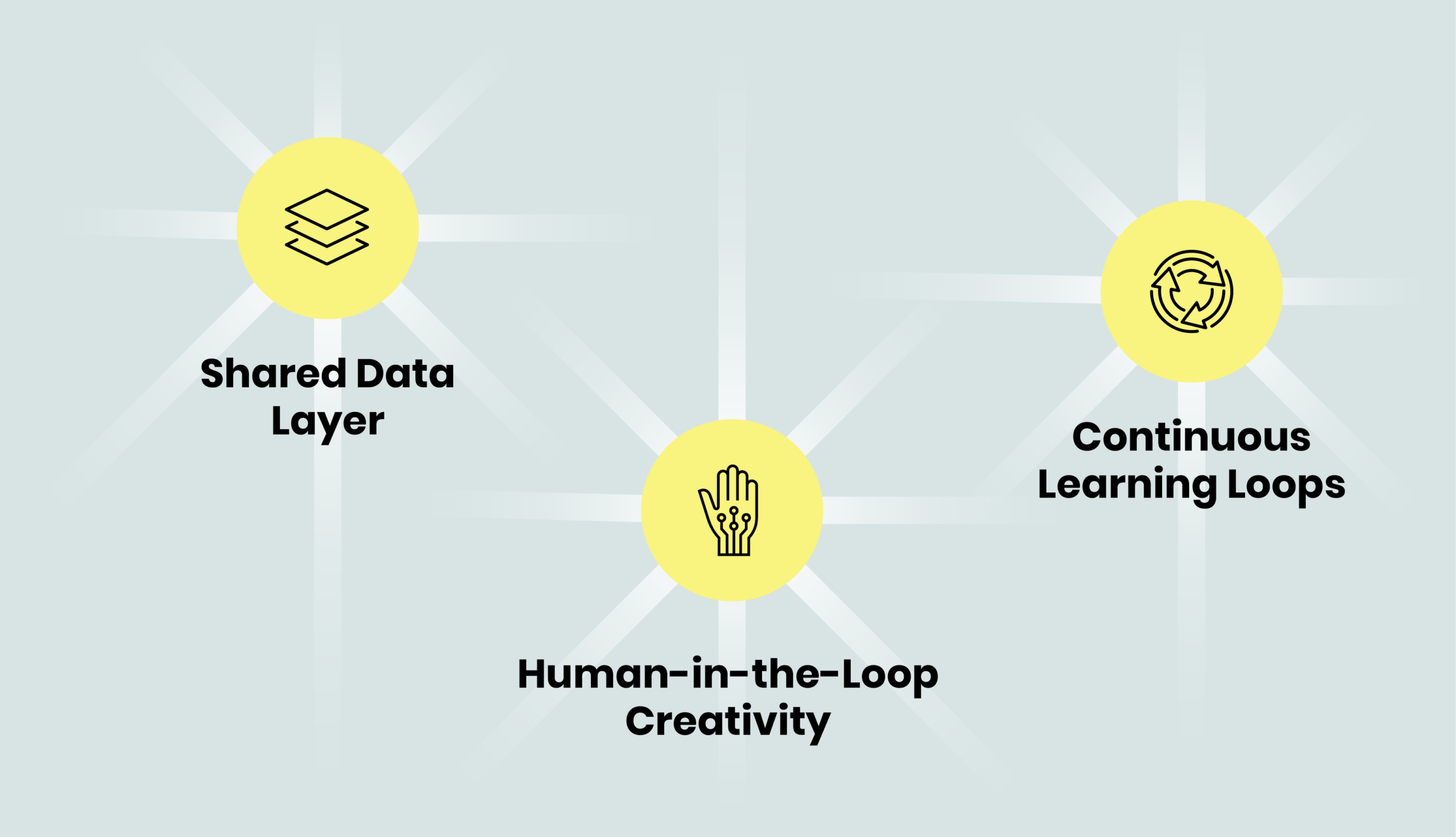
Across all eight organisations, three consistent principles define success:
- Shared Data Layer: Each company has established a unified intelligence core — a ‘single source of truth’ where marketing, sales, and product signals converge.
- Human-in-the-Loop Creativity: Despite automation, human strategy, brand narrative, and ethical oversight remain essential. AI manages the mechanics; people define the meaning.
- Continuous Learning Loops: The most successful systems don’t just automate; they learn. Every action feeds back into the next, improving accuracy, timing, and alignment over time.
As Harvard Business Review puts it:
AI turns alignment from an aspiration into a process — not coordination by meeting, but by model.
Why This Matters
The move towards AI-driven GTM orchestration represents more than an efficiency play. It’s a cultural shift, from siloed, linear thinking to networked, adaptive learning.
The CMOs, CROs, and product leaders driving this transformation understand that their future advantage lies not in owning the most data, but in connecting it the fastest.
As these companies demonstrate, GTM alignment is no longer achieved through off-sites or org charts. It’s achieved through systems.
Conclusion: Alignment And Synchronisation Are Key
The future of go-to-market belongs to organisations that think as one. AI is becoming the GTM brain, interpreting, connecting, and guiding decisions across the full commercial ecosystem.
The companies leading this transformation; Salesforce, Adobe, HubSpot, Microsoft, Snowflake, Atlassian, ZoomInfo, and Nvidia are proving that growth now depends less on scale and more on synchronisation.
As Tomorrow People believes, the next competitive edge won’t be about faster campaigns or cheaper content. It will be about AI-driven alignment where every team, tool, and touchpoint shares one brain, one truth, and one direction.
The future of GTM isn’t automation. It’s orchestration.
Read the latest positioning trends and insights.
Tap into our brand and product positioning, storytelling, and creative expertise to inspire your next strategic move.