
The Death of the Big Launch: Why Agile Go-to-Market Is Replacing Long Planning Cycles
For decades, the annual ‘big launch’ was the heartbeat of go-to-market strategy. Teams spent months crafting messaging, aligning departments, and preparing for the moment everything went live; the press release, the campaign push, the product reveal.
But today, that rhythm feels out of step with reality. Markets shift faster than plans can be approved. Customer expectations change week to week. AI tools accelerate competitive reactions in real time. As a result, CMOs who cling to traditional planning cycles are finding that by the time their grand campaigns hit the market, the opportunity has already moved on.
This is why leading marketing and growth organisations are abandoning long planning cycles in favour of agile, real-time GTM models. Ones built around continuous testing, shorter iterations, and signals that trigger rapid adjustments. The age of the “big launch” isn’t just fading; it’s becoming a liability.
Why the Big Campaign Model Is Breaking Down
The traditional go-to-market model was designed for predictability: annual plans, fixed budgets, and set milestones. But today’s commercial environment runs on unpredictability.
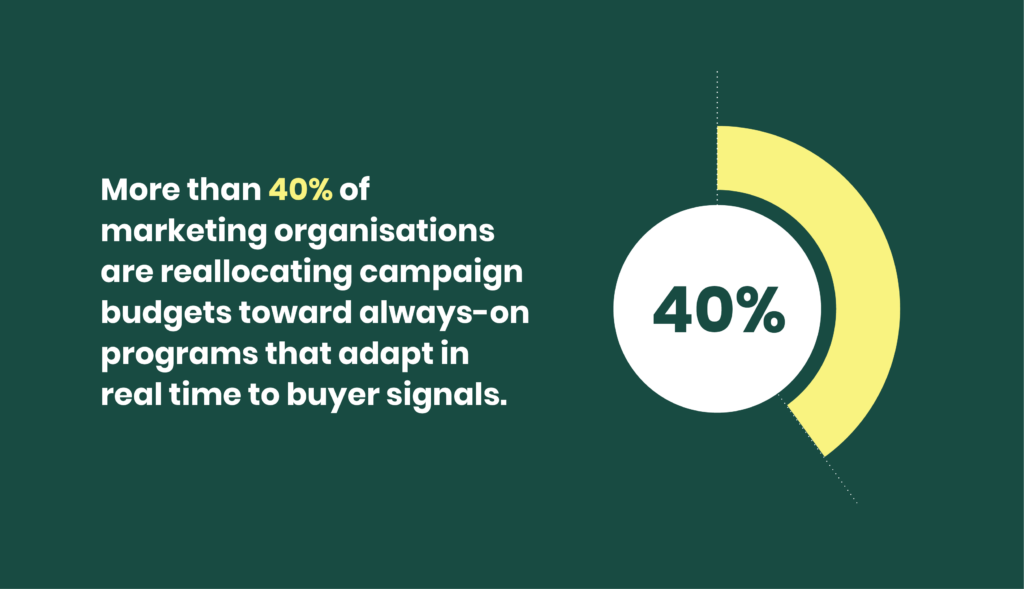
According to Gartner’s 2025 CMO Agenda, more than 40% of marketing organisations are reallocating campaign budgets toward always-on programs that adapt in real time to buyer signals. This isn’t simply an operational tweak; it’s a structural shift in how brands think about momentum, measurement, and control.
The old approach assumed that buyers moved through predictable stages: awareness, interest, decision. Campaigns could therefore be planned months in advance.
But digital ecosystems no longer move linearly. Customers are in a constant state of research and comparison. Channels multiply faster than teams can staff them. AI-powered recommendation engines alter attention dynamics daily.
In that environment, the ‘set-and-launch’ model has become not only slow, but strategically dangerous. It locks teams into rigid execution plans, leaving little room for adaptation when new insights appear.
As Forrester’s Future of Demand Marketing Report notes:
“Static campaign calendars are giving way to dynamic, insight-led micro-launches. Fast cycles that test ideas, measure engagement, and evolve messaging continuously.”
How Agile Go-to-Market Works in Practice
Agile GTM is not about moving recklessly fast or abandoning strategy. It’s about embedding responsiveness and learning into every layer of execution.
A recent McKinsey State of Growth Report (2025) found that “marketing organisations operating in sprint cycles outperform traditional campaign teams by 32% in revenue velocity.” These teams don’t wait for quarterly reviews to act. They treat the go-to-market process as an ongoing conversation with the market, sensing, adjusting, and optimising.
In agile GTM organisations, campaign planning happens in shorter, iterative bursts. Small, cross-functional teams are empowered to test ideas and redeploy resources based on what’s working now, not what was forecast six months ago.
As Salesforce Ventures’ Efficient Growth Report (2025) describes it:
“Launch once, iterate forever.”
Rather than treating the launch as the end of the process, it becomes the beginning of a feedback loop. One continuously refined by customer signals, sales data, and performance analytics. This shift doesn’t eliminate the need for strategic vision. It reframes it, with strategy becoming a directional compass, not a rigid map.
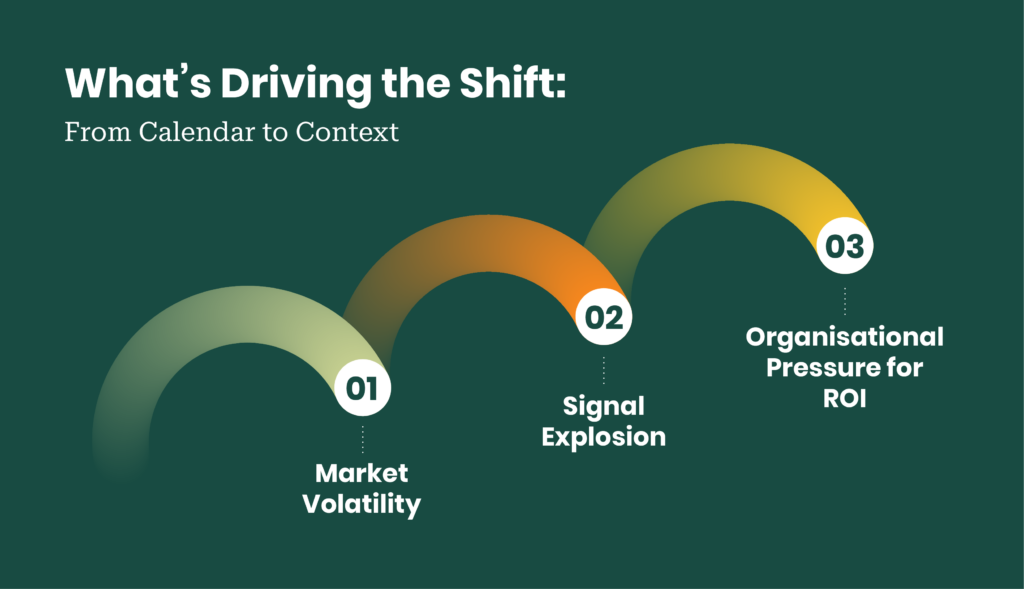
What’s Driving the Shift: From Calendar to Context
Three forces are accelerating the adoption of agile GTM models.
- Market Volatility
Economic uncertainty, competitive saturation, and disruptive innovation have shortened opportunity windows. The half-life of a campaign insight has never been shorter. Planning twelve months ahead is like trying to forecast the weather for next year. - Signal Explosion
Data now flows in real time from CRM systems, web analytics, social listening, and audience-insight platforms like TelmarHelixa. CMOs no longer need to rely on assumptions; they can detect buying intent, channel fatigue, and message resonance almost instantly. The challenge is acting on those signals quickly enough. - Organisational Pressure for ROI
Boards and CFOs expect proof of impact within weeks, not quarters. Agile GTM enables faster learning cycles and tighter ROI feedback loops, a language the executive suite understands.
Together, these forces make the traditional campaign calendar obsolete. Today’s GTM leaders are building systems designed to respond at the speed of attention.
Lessons from Agile Go-to-Market Leaders
Across industries, agile GTM pioneers are redefining what “launch” even means. In technology, product-led growth companies now deploy updates and campaigns weekly. Marketing, sales, and customer success teams work in sprints, sharing real-time performance dashboards that refresh daily.
One global SaaS brand described its transformation this way:
“We realised the campaign was never finished, it just changed form. Instead of launching once, we launch a little bit every week.”
This approach mirrors agile product development: deliver smaller increments, gather feedback early, and evolve constantly. But it also requires a cultural shift. Marketing teams accustomed to perfecting every deliverable must get comfortable shipping early and improving often.
As Forrester observed:
“The mindset shift from perfection to progression is what separates agile marketing leaders from the rest.”
The Human Element: Empowerment Over Approval
Agility isn’t just a process. It’s a mindset. It demands trust, autonomy, and distributed decision-making.
Traditional GTM structures are hierarchical: strategy teams plan, creative teams execute, analytics teams report. But that fragmentation slows responsiveness. Agile GTM requires collapsing those silos into empowered, cross-functional squads with shared KPIs.
Salesforce Ventures highlights this in their analysis of efficient-growth models: “High-performing GTM teams are structured around rapid iteration and distributed accountability.”
When individuals closest to the customer can adapt tactics in real time without waiting for top-down approval, the organisation becomes exponentially faster and smarter.
How CMOs Can Begin the Transition
Moving from traditional GTM to agile GTM doesn’t happen overnight. But it can start with three foundational shifts.
First, replace campaigns with continuous initiatives. Stop thinking in terms of ‘launch, measure, close.’ Build rolling programs that adjust weekly based on engagement data.
Second, align around shared signals, not separate metrics. Sales, product, and marketing should all see the same intelligence, buyer intent, content performance, and conversion velocity. When the data view is shared, so is accountability.
Third, adopt sprint-based planning. Break quarterly goals into two-week cycles with clear hypotheses, testable actions, and measurable results. Evaluate and pivot.
The transition is less about speed for its own sake and more about institutionalising learning velocity.
The Future of GTM: Continuous Momentum
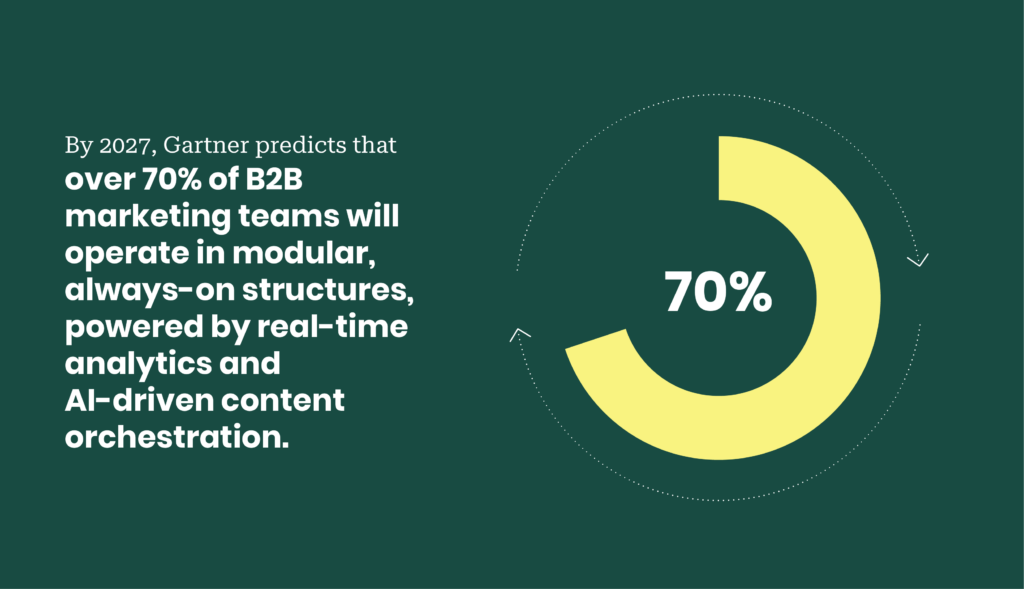
The shift toward agile GTM isn’t a trend. It’s the new normal for sustained competitiveness. By 2027, Gartner predicts that over 70% of B2B marketing teams will operate in modular, always-on structures, powered by real-time analytics and AI-driven content orchestration.
Those who adapt now will discover that agility compounds. Each cycle generates data, insight, and improvement; a self-reinforcing loop of performance.
In the words of McKinsey:
“The future of growth will belong to organisations that can learn faster than their markets change.”
For CMOs, that means leaving behind the comfort of certainty and embracing the discipline of iteration. The big launch isn’t dying because planning is bad; it’s dying because the world no longer waits for your plan.
FAQ: Agile Go-to-Market in 2026 and Beyond
- What is an agile go-to-market (GTM) strategy?
An agile GTM strategy replaces rigid, long-term planning with short, iterative cycles of execution and learning. It enables teams to respond to real-time data and buyer signals instead of fixed calendars. - Why are long campaign cycles becoming obsolete?
Markets change faster than annual plans can adapt. Gartner reports that over 40% of CMOs have already shifted to always-on, adaptive programs that deliver results sooner. - How do agile GTM teams measure success?
They prioritise learning velocity, revenue acceleration, and conversion efficiency over vanity metrics. Data and insight cadence become as important as output. - Does agile GTM work for large enterprises?
Yes. Global enterprises such as Salesforce and Adobe have adopted agile planning frameworks precisely to increase speed, reduce waste, and improve responsiveness at scale.
Conclusion: the age of continuous launch
The companies that will thrive in the next era of go-to-market aren’t the ones with the biggest campaigns. They’re the ones with the shortest distance between signal and action.
Agile GTM is about more than speed. It’s about responsiveness, experimentation, and building systems that evolve with the market, not behind it.
If your next campaign plan still starts with a 12-month calendar, consider this your invitation to rethink what ‘go-to-market’ really means.
Don’t launch once. Launch forever.
About the author:
Partner at Tomorrow People
Pete is a strategic marketing leader specialising in positioning, go-to-market strategy, growth and AI-enabled marketing performance. He has worked with organisations including Schneider Electric, TechData, Atos, Microsoft, Reachdesk, ABB, TelmarHelixa, Trustpilot, Company365, GlobalData and more, helping brands sharpen their market position, strengthen go-to-market execution and accelerate growth.
His work focuses on turning complex propositions into clear market narratives, aligning commercial teams around stronger positioning and improving marketing performance through the smart application of AI. From category development and messaging to launch strategy and growth planning, Pete brings a practical, commercially grounded perspective shaped by hands-on experience across B2B and enterprise environments.
Pete has also spoken at Content Marketing World, where he has contributed to industry conversations on positioning, growth and the changing role of AI in modern marketing. He writes about the strategies, decisions and operating models that help ambitious brands move faster, communicate more clearly and perform more effectively.
Read the latest positioning trends and insights.
Tap into our brand and product positioning, storytelling, and creative expertise to inspire your next strategic move.